Best Insoles for High Arches (2026 Buyer Guide)
People with high arches often assume they’re “lucky” compared to flat-footed individuals. But in reality, high arches can create just as many problems — sometimes even more.
If you have high arches, you may notice:
- Sharp heel pain after standing
- Pressure on the ball of your foot
- Ankle instability
- Frequent foot fatigue
- Pain that radiates up into the knees or lower back
Unlike flat feet, high arches don’t absorb shock well. Your foot stays rigid instead of flexing naturally. That rigidity forces impact to travel upward through your joints.
That’s why choosing the best insoles for high arches isn’t about extra padding alone. It’s about proper arch contour, shock absorption, and controlled flexibility.
Let’s break down what actually matters — so you choose correctly the first time.
People with high arches often experience pressure that isn’t distributed evenly, which can lead to discomfort similar to arch pain support solutions.
Understanding High Arches (Pes Cavus)
High arches, sometimes called pes cavus, occur when the arch of the foot is raised higher than normal. Instead of distributing weight evenly across the foot, pressure concentrates on:
- The heel
- The forefoot (ball of the foot)
This imbalance creates two key problems:
- Poor shock absorption
- Reduced stability during walking or running
Over time, that can lead to:
- Plantar fasciitis
- Metatarsalgia
- Stress fractures
- Ankle sprains
- Knee discomfort
Because the foot is more rigid, it doesn’t flatten naturally under load. That means your body absorbs more force with every step.
The right support insert helps by:
- Redistributing pressure
- Providing structured arch contact
- Enhancing shock absorption
- Improving alignment
- Reducing impact stress
While high arches are different from flat feet, understanding the differences is important — see flat feet vs overpronation explained .
Why Standard Insoles Fail for High Arches
Most factory shoe inserts are thin foam liners designed for general comfort. They do not account for structural differences like high arches.
Here’s why they fail:
1. They Don’t Fill the Arch Gap
People with high arches have a larger space between the foot and the shoe. Standard inserts don’t contour into that space properly. The result?
Your foot continues to bear weight unevenly.
2. They Lack Shock Absorption
Rigid, high-arched feet need cushioning that absorbs impact. Basic inserts compress too quickly and provide little long-term protection.
3. They Offer Minimal Stability
Because high arches can increase ankle instability, proper support is critical. Generic liners don’t provide heel stabilization or structured arch reinforcement.
This is where the best insoles for high arches differ — they combine cushioning with shape-specific contouring.
In many cases, high arches can also affect alignment, similar to what happens with overpronation and foot imbalance .
What Features Matter Most
When shopping for supportive inserts for high arches, focus on balance — not extremes.
1. Contoured Arch Support (Not Flat, Not Aggressive)
You need an insert that fills the arch without feeling intrusive. Too little support leaves pressure unbalanced. Too much rigidity can create discomfort.
Look for:
- Anatomically shaped arch zones
- Moderate firmness
- Even contact across the midfoot
2. Shock-Absorbing Cushioning
Because high arches don’t dissipate impact well, cushioning becomes essential.
Materials that perform well:
- EVA foam
- Polyurethane
- Multi-density foam layers
Avoid ultra-thin inserts. You need material that absorbs force without collapsing immediately.
3. Heel Stabilization
A deep heel cup helps anchor the rearfoot. This improves alignment and reduces ankle rolling — common in people with high arches.
4. Forefoot Padding
Pressure often builds at the ball of the foot. Quality inserts include extra padding in this area to prevent metatarsal pain.
5. Durable Construction
High arches create concentrated pressure points. Cheap inserts flatten quickly.
Look for:
- Reinforced arch shells
- Compression-resistant foam
- Structured base layers
If you’re on your feet all day, you may also want to consider options designed for long standing hours like standing all day support
How to Choose the Best Insoles for High Arches
Before purchasing, consider your activity level.
Ask yourself:
- Do I stand all day at work?
- Do I run or train regularly?
- Is my pain mostly in the heel or forefoot?
- Do I experience ankle instability?
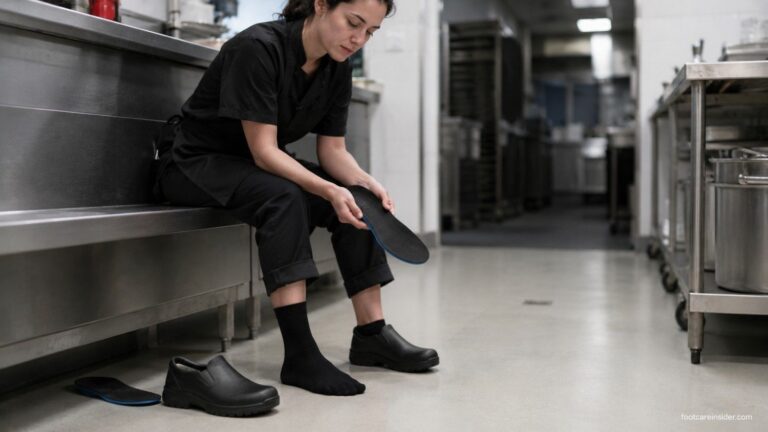
For Work or Standing All Day
Choose moderate arch contour + strong shock absorption.
Durability is critical.
Certain professions require extra support, especially in demanding environments like insoles for nurses working long shifts .
For Running or Sports
Prioritize impact control and flexibility.
Look for performance-oriented cushioning.
For Daily Casual Wear
Low-to-mid profile inserts with balanced cushioning work well.
Remember — the goal is not to “flatten” your arch.
It’s to support it while redistributing pressure.
The best insoles for high arches provide structure and cushioning without forcing unnatural correction.
Common Mistakes to Avoid
• Choosing ultra-soft gel inserts with no structure
• Buying the highest arch support available without testing comfort
• Ignoring shoe compatibility
• Replacing shoes but not the worn-out insert
Support must match your foot and your footwear.
Buying Framework (Simple Decision Guide)
Use this 4-step method:
Step 1: Identify your main pain point (heel, ball, ankle, fatigue).
Step 2: Match support level to activity level.
Step 3: Check arch contour height and firmness.
Step 4: Ensure proper fit inside your shoe type.
When those four align, you significantly reduce trial-and-error purchases.
Now that you understand what features matter most, let’s break down the five main categories of inserts designed for high arches — who they’re best for, and where each performs well or falls short.
Proper support plays a key role in full-body alignment — here’s how insoles improve posture and alignment .
1. Firm Orthotic Arch Support Insoles
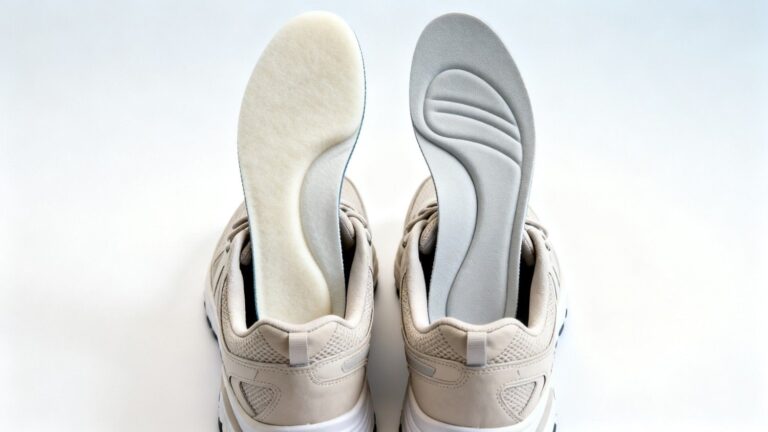
These are structured inserts built with a semi-rigid or rigid arch shell. Unlike soft foam liners, they provide consistent midfoot contact and stabilize the heel.
Best for:
- Moderate to severe high arches
- Chronic heel pain
- Recurring ankle instability
- Long daily wear
Pros:
- Strong structural support
- Excellent alignment control
- Durable construction
- Reduces pressure imbalance
Limitations:
- May feel firm during break-in
- Less plush than heavily cushioned options
- Not ideal for very tight shoes
Comparison Insight:
If your main issue is instability or chronic pain, this category offers more correction than soft comfort inserts. For many users, this is where the best insoles for high arches deliver the most long-term value.
2. Shock-Absorbing Cushion Insoles
These prioritize impact reduction. They usually combine multi-density foam with moderate arch contouring.
Best for:
- Heel pain
- Standing on hard surfaces
- High arches with impact sensitivity
- Work environments
Pros:
- Excellent shock absorption
- Reduces heel strike stress
- Comfortable from day one
- Good for long shifts
Limitations:
- Less structural control than rigid orthotics
- May compress over time
- Not ideal for severe instability
Comparison Insight:
If your primary complaint is impact pain rather than instability, a shock-focused design may outperform very rigid support. Many people searching for the best insoles for high arches actually need cushioning first — structure second.
3. Deep Heel Cup Stability Insoles
These inserts emphasize rearfoot alignment. The deep heel cradle keeps the foot centered and reduces rolling.
Best for:
- Ankle instability
- Frequent sprains
- Uneven shoe wear
- Balance issues
Pros:
- Strong heel alignment
- Improves stability
- Enhances weight distribution
- Supports arch contact
Limitations:
- Arch height varies by model
- May feel bulky in low-profile shoes
Comparison Insight:
If you feel your ankle wobble during movement, heel stabilization may matter more than maximum arch height. Stability and shock control must work together.
4. Memory Foam with Structured Arch Zones
Unlike flat gel inserts, these combine cushioning layers with defined arch shaping.
Best for:
- Mild high arches
- Casual daily wear
- Light activity
- Comfort-focused users
Pros:
- Immediate comfort
- Even pressure distribution
- Flexible feel
- Affordable option
Limitations:
- Not ideal for severe structural issues
- Foam may lose shape over time
- Limited correction
Comparison Insight:
If your discomfort is mild and you prioritize softness, this option can work. However, for moderate pain or instability, firmer support usually performs better.
5. Performance Insoles for Running & Sports
These are engineered for dynamic movement. They combine arch contouring with energy-return materials and targeted cushioning zones.
Best for:
- Runners with high arches
- Gym training
- High-impact sports
- Athletic footwear
Pros:
- Enhanced shock control
- Arch stability during motion
- Reduces fatigue
- Designed for repetitive impact
Limitations:
- May feel firm for casual use
- Not always ideal for work boots
Comparison Insight:
Athletic inserts are optimized for motion rather than standing. If you train regularly, performance-focused models are often the best insoles for high arches in active settings.
Frequently Asked Questions
Do high arches need more cushioning or more support?
Both. High arches require cushioning to absorb shock and structured arch contact to distribute pressure evenly.
Can insoles lower high arches?
No. Inserts do not permanently change foot structure. They improve comfort, stability, and alignment.
How long do arch support inserts last?
Most high-quality options last 6–12 months depending on activity level and body weight.
top insoles for arch pain relief
Are custom orthotics better?
Custom orthotics can help severe structural cases. However, many over-the-counter options provide excellent relief for moderate symptoms.
Can high arches cause knee or back pain?
Yes. Because rigid arches reduce shock absorption, impact can transfer upward to the knees, hips, and lower back.
If you also experience knee discomfort, you may benefit from exploring insoles for knee pain relief .
Clear Verdict
The best insoles for high arches combine structured arch contouring with shock-absorbing cushioning and heel stability.
If your pain stems from impact stress, prioritize cushioning.
If instability is the main issue, choose firmer orthotic support.
For athletes, select performance-driven inserts built for motion control.
Match the insert to your activity level — not just your arch type.
Balanced support always outperforms extreme softness.
To improve posture and reduce pressure on your feet, take a look at our guide on best insoles for overpronation.
If your issue is related to foot shape rather than arch height, you can also check the best insoles for wide feet here.
If you’re on your feet all day at work, it’s worth looking at the best insoles for nurses here.