Flat Feet vs Overpronation: What’s the Real Difference?
When researching foot pain, arch support, or stability shoes, two terms appear constantly: flat feet and overpronation. They’re often used interchangeably — but they are not the same thing.
Understanding the difference matters because treatment, shoe selection, and insole support vary depending on which condition you actually have.
This guide breaks down flat feet vs overpronation in a clear, side-by-side way so you can determine what applies to you — and what kind of support you really need.
Our guide to flat feet covers the causes, symptoms and options in one place.
Flat feet and overpronation are often confused, but both can lead to discomfort requiring insoles for arch pain relief .
Short answer: flat feet describe the shape of your arch. Overpronation describes how your foot moves when you walk or run. Flat feet often lead to overpronation, but you can have one without the other. Underpronation (supination) is the opposite movement, where the foot rolls outward, and it is more common with high arches.
What Are Flat Feet?
Flat feet — also called fallen arches — occur when the arch of the foot collapses or is very low when standing. In some people, the arch never fully develops. In others, it gradually flattens over time due to age, weight changes, injury, or tendon weakness.
There are two main types:
- Flexible flat feet: An arch appears when sitting but flattens when standing.
- Rigid flat feet: The arch is absent even when off weight.
Flat feet describe a structural shape of the foot.
Some people with flat feet experience no pain at all. Others may feel discomfort in the arch, heel, ankles, or even knees due to alignment changes.
Choosing the right correction method is key, especially when using insoles for overpronation and alignment support .
If you’re specifically looking for structured arch support insoles, this detailed breakdown of the best options for flat feet explains what firmness level and arch height to look for.
What Is Overpronation?
Overpronation refers to the motion of the foot during walking or running. Pronation is normal — it’s the inward rolling motion that helps absorb shock. But when the foot rolls inward excessively, that’s overpronation.
Overpronation is about movement mechanics, not arch height.
It typically happens during the gait cycle when the ankle collapses inward too much, placing strain on the arch, plantar fascia, and posterior tibial tendon.
Someone can:
- Have flat feet and overpronate
- Have flat feet without overpronating significantly
- Have normal arches and still overpronate
This is why the comparison between flat feet vs overpronation is important — one describes foot structure, the other describes foot function.
For runners and active individuals, properly designed stability shoes can significantly reduce inward ankle collapse and improve overall gait control.
Structural Differences
Here’s the core distinction:
| Flat Feet | Overpronation |
|---|---|
| Structural condition | Movement pattern |
| Arch is low or collapsed | Foot rolls inward excessively |
| Visible when standing | Observed during walking/running |
| May be genetic | Often biomechanical |
Flat feet are easier to identify visually. Stand barefoot and check your arch in a mirror or perform a wet footprint test. If the full sole of your foot appears in the imprint, your arch is likely low.
Overpronation usually requires observing gait — either by a professional or through wear patterns on shoes. Excessive wear on the inner edge of the sole is a common indicator.
How Pronation Works: Overpronation, Neutral and Underpronation
Pronation is the natural inward roll of the foot after the heel lands. It absorbs shock, and a certain amount is healthy. Where your foot sits on the scale decides what support helps.
| Type | What it looks like |
|---|---|
| Overpronation | The foot rolls inward too much. The arch is usually flat or low, but can be normal. Shoes wear on the inner edge of the heel and forefoot. |
| Neutral pronation | The foot rolls inward a normal amount. The arch is medium. Shoes wear evenly, slightly on the outer heel. |
| Underpronation (supination) | The foot rolls outward and absorbs little shock. The arch is usually high. Shoes wear on the outer edge of the sole. |
So flat feet tend to go with overpronation, and high arches tend to go with underpronation, but this is a tendency and not a rule. If you suspect the opposite pattern, read overpronation vs supination. For how far the inward roll can go, see mild vs severe overpronation, and for the reasons behind it, the causes of overpronation.
Which One Do You Have? A Quick Self-Test
| Test | Points to flat feet | Points to overpronation |
|---|---|---|
| Wet footprint (stand on paper after wetting your foot) | Most of the sole prints, with little or no curve on the inside | Arch may look normal |
| Shoe wear | Not a reliable sign by itself | Heavy wear on the inner heel and ball of the foot |
| Heels from behind (ask someone to film you walking away) | Not always visible | Heels and ankles tilt inward as you step |
| Standing on tiptoes | Arch stays flat in rigid flat feet, appears in flexible flat feet | Not relevant |
Most people end up with one of three answers: flat feet only, overpronation only, or both. If you got both, structured arch support in a stable shoe usually covers it. Why flat feet develop in the first place is covered in what causes flat feet.
Materials & Functional Differences in Support Solutions
When addressing flat feet vs overpronation, the support tools may overlap — but their function differs slightly.
For Flat Feet:
Support typically focuses on:
- Firm arch support
- Structured midsoles
- Semi-rigid orthotics
- Deep heel cups for alignment
Materials often include:
- EVA foam with firm density
- Polyurethane arch inserts
- Thermoplastic stabilizers
The goal is to restore arch positioning and reduce strain on ligaments and tendons.
Some people experience the opposite issue, which requires different support — see support for high arches .
For Overpronation:
Support focuses on:
- Motion control
- Medial posting (extra support on the inner side)
- Stability shoes
- Structured heel counters
Materials often include:
- Dual-density midsoles
- Reinforced medial foam
- Stability plates
The goal is to control inward rolling, not just support the arch.
Intended Use Cases
Flat Feet Support Is Typically Used For:
- General arch fatigue
- Standing all day
- Mild plantar fasciitis
- Foot strain
- Preventative support
Many people with flat feet need consistent arch structure in everyday shoes, even if they don’t overpronate significantly.
Proper alignment also impacts your full body — learn how insoles improve posture and alignment .
Overpronation Support Is Typically Used For:
- Running or walking long distances
- Shin splints
- Knee pain caused by misalignment
- Posterior tibial tendon strain
- Recurring plantar fasciitis linked to gait issues
Overpronation solutions are often more performance-oriented because excessive inward rolling increases injury risk during repetitive movement.
Cost Differences
Cost varies depending on whether you’re addressing structure or motion.
Flat Feet Solutions:
- Basic arch support insoles: $20–$50
- Higher-quality orthotic inserts: $50–$100
- Custom orthotics: $200–$400+
Overpronation Solutions:
- Stability shoes: $90–$160
- Motion control shoes: $120–$180
- Stability insoles: $40–$100
If both conditions overlap, costs may increase since you might need both structured support and motion control.
In general, treating overpronation through footwear tends to cost slightly more than addressing mild flat feet alone.
Pros & Cons Breakdown
Flat Feet
Pros:
- Easy to identify
- Often manageable with simple arch support
- Many affordable insole options
- Not always painful
Cons:
- Can lead to strain over time
- May contribute to overpronation
- Requires consistent support in most footwear
- Severe cases may need medical intervention
Overpronation
Pros:
- Can often be corrected with proper shoes
- Stability footwear widely available
- May improve with strengthening exercises
- Treatable without custom devices in many cases
Cons:
- Harder to self-diagnose
- Can lead to knee, hip, and back pain
- Running injuries more common
- Often requires more structured footwear
Who Should Choose Flat Feet Support?
You likely need arch-focused support if:
- Your arch visibly collapses when standing
- You experience arch fatigue after long days
- You feel soreness in the inner arch
- You stand more than you run
- Your shoes don’t show severe inward wear
Flat feet support works well for daily comfort and posture correction.
If your main concern is fatigue from standing all day, cushioned support combined with moderate arch structure may be more important than full motion control.
Who Should Choose Overpronation Support?
You likely need motion-control support if:
- Your ankles visibly roll inward while walking
- Your running shoes wear heavily on the inside edge
- You experience shin splints
- You’ve had recurring plantar fasciitis
- Knee pain worsens after activity
In these cases, stability shoes or motion-control footwear may be more important than simple arch inserts.
Excessive strain from flat feet or overpronation can contribute to plantar fasciitis, especially if proper arch and heel support isn’t used consistently.
Examples That Match Each Case
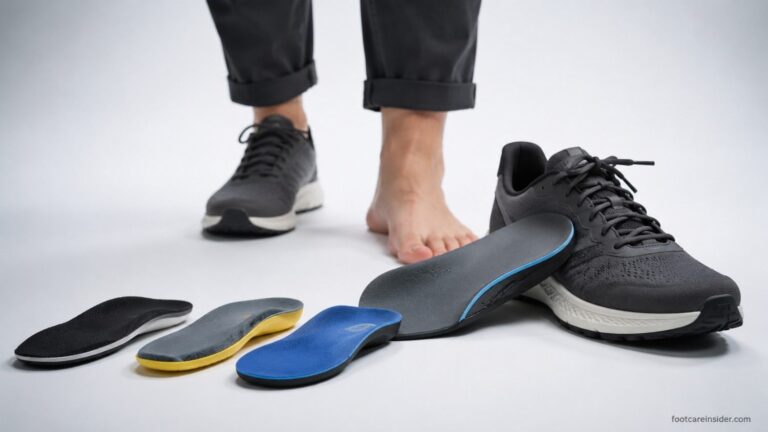
Two insoles that fit the two cases above. Which one suits you depends on your answer in the self-test.
Flat feet, daily standing and walking: Superfeet Green – firm, structured arch support that holds its shape.
Overpronation, active or on your feet a lot: Stability Running Insoles – a deeper heel cup and firm medial support to limit the inward roll.
Long-Term Durability Comparison
Arch support insoles for flat feet typically last:
- 6–12 months depending on material quality
- Shorter lifespan if made of soft foam
Stability shoes for overpronation typically last:
- 300–500 miles for running
- 6–12 months for daily walking
Rigid orthotics for flat feet often outlast foam-based stability inserts.
If both issues exist, rotating shoes and replacing inserts regularly is important to prevent recurrence of pain.
Frequently Asked Questions
Are flat feet and overpronation the same?
No. Flat feet describe structure, while overpronation describes movement. They often occur together but are not identical.
Can you have overpronation without flat feet?
Yes. Some people have normal arches but still experience excessive inward movement during walking.
Can flat feet exist without overpronation?
Yes. In some cases, the arch is low but movement remains stable.
Can overpronation happen with normal arches?
Yes. Arch height does not automatically determine pronation level.
Does flat feet always cause pain?
No. Many people with flat feet have no symptoms.
Is overpronation dangerous?
Not inherently. But excessive inward rolling increases stress on joints over time.
Should I see a professional?
If pain persists beyond a few weeks, worsens with activity, or affects mobility, evaluation by a podiatrist is recommended.
Do flat feet cause overpronation?
Often, yes. When the arch lowers, the foot tends to roll inward more as it takes weight. It is not guaranteed: some people with flat feet keep a stable, neutral movement.
What is the difference between overpronation and underpronation?
Overpronation is too much inward roll, usually with low arches. Underpronation (supination) is too little, so the foot rolls outward and absorbs less shock, usually with high arches. Our page on overpronation vs supination goes through both.
Can I fix overpronation if I have flat feet?
You can usually manage it. Supportive shoes, structured insoles and strengthening reduce the strain, even though a structural flat foot itself will not turn into a high arch. See mild vs severe overpronation for what to expect at each level.
Final Verdict: Flat Feet vs Overpronation
Flat feet describe the shape of your arch.
Overpronation describes the movement of your foot.
They overlap frequently — but they are not the same condition.
If your issue is structural and arch-based, focus on supportive insoles and firm arch reinforcement.
If your issue is movement-based and linked to running injuries or inward rolling, focus on stability footwear and motion control.
For many people, the correct solution is identifying which condition applies first — and choosing footwear accordingly.
If you’re dealing with foot alignment issues, check our guide on best insoles for overpronation to improve support and stability.