Do Compression Boots Actually Work? What the Research Says
You may have seen compression boots everywhere from professional sports facilities to home recovery rooms, often presented as a faster way to deal with sore, heavy legs after training. That can make the evidence difficult to judge. Are the inflatable boots actually doing something measurable, or do they mainly feel good for 20 minutes? The answer is more nuanced than either extreme. Research suggests compression boots can reduce perceived muscle soreness after exercise, but the evidence is much less convincing when the goal is improving objective performance or changing biological markers of muscle damage.
Compression boots appear to have their clearest benefit in how recovered and sore people feel, rather than in reliably making them perform better. A 2024 systematic review and meta-analysis found small-to-moderate effects on pain and soreness after exercise, while effects on muscle performance were trivial or not statistically significant across the measured recovery windows.
What Compression Boots Actually Do
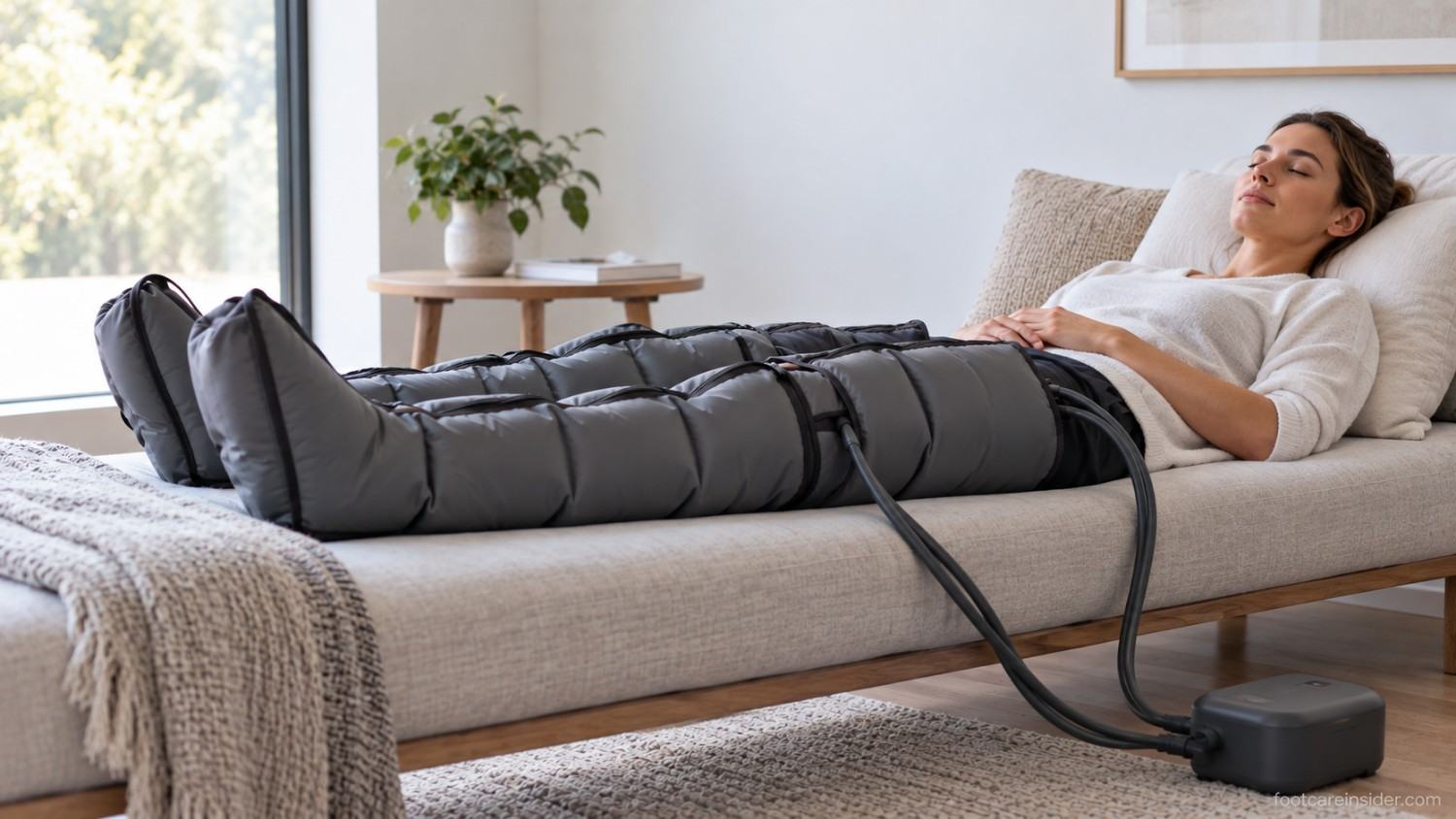
Compression boots use inflatable chambers that wrap around the lower legs and, in many systems, extend toward the thighs. The chambers inflate and release pressure in sequence rather than squeezing the entire leg equally at once. That makes them different from ordinary compression socks or a vibrating leg massager.
A closer look at sore legs: Normatec boots for sore legs.
The practical appeal is straightforward. After a hard run, cycling session, or demanding workout, you put the boots on while resting rather than continuing to move around. The compression creates a noticeable squeezing sensation and gives you a structured recovery session without requiring much effort.
This can also appeal to people whose legs feel tired after long periods of standing or sitting, although much of the sports-recovery research has focused on healthy, active populations rather than people using compression for a diagnosed medical condition. The evidence should therefore not be stretched beyond the populations actually studied.
Readers considering whether the evidence justifies buying a system can compare the findings with the available options in Best Compression Boots for Recovery (2026): Buying Guide.
What the Research Says About Soreness and Recovery
The strongest evidence is around post-exercise soreness, including the type of discomfort associated with delayed-onset muscle soreness, or DOMS.
In the 2024 meta-analysis, the effect on soreness was small during the first two hours after exercise, became more meaningful around 48 hours, and remained evident in the later recovery window examined by the researchers. That timing is particularly relevant because soreness commonly becomes more noticeable during the day or two after harder training rather than immediately after the workout.
For someone training several times per week, that can make compression boots practically useful even if the effect is modest. A runner who feels less stiff the following day may find the recovery session worthwhile, particularly when the next training session is approaching.
The 2024 review included 17 studies involving 319 participants and found that lower-limb intermittent pneumatic compression showed a trivial-to-moderate effect on pain and soreness, with the most consistent practical signal being reduced perceived soreness.
The review found that protocols around 20–30 minutes and pressures around 80 mmHg were among the most commonly used in the available studies. A later evidence guide similarly describes research-supported consumer protocols around 15–30 minutes, commonly within a 60–90 mmHg range, while emphasizing that these are research patterns rather than universal instructions for every person or device.
Where the Evidence Gets Much Thinner
The biggest mistake is assuming that less soreness automatically means better athletic performance. The research does not clearly support that jump.
In the 2024 review, measured muscle-performance outcomes showed little meaningful improvement overall. Effects were non-significant in the earliest window and generally trivial over the following 24–72 hours. In other words, someone may feel better recovered without producing a clearly measurable improvement in strength or performance.
Blood markers are even less straightforward. Creatine kinase results varied substantially between studies, while inflammatory markers such as CRP and IL-6 did not show a consistent pattern. Lactate clearance also did not demonstrate a significant benefit in the review.
That makes the most defensible conclusion fairly simple: compression boots may be useful as a recovery tool for soreness and perceived readiness, but the current research does not justify promising faster muscle repair, better athletic performance, or a universal physiological advantage.
How Much Does the Recovery Feeling Matter?
This is where the answer becomes more individual.
A recreational runner who finishes a long weekend run with heavy calves may value a 20- to 30-minute session because the legs simply feel better afterward. Someone training twice a day may also find reduced soreness useful because there is less time between sessions.
But a person expecting compression boots to produce a clearly measurable increase in strength, speed, or next-session performance should have more modest expectations. There is also no strong reason to assume that a more expensive boot automatically produces proportionally better recovery — more zones, app control, and finer pressure adjustment may make the experience easier to personalize, but the basic evidence does not establish a simple “more expensive equals more effective” rule.
Who Should Consider Using Compression Boots?
They make the most sense for active people who experience recurring post-exercise soreness and want a convenient recovery ritual they can repeat at home — runners, cyclists, strength-training enthusiasts, and other recreational or competitive athletes who regularly notice DOMS or heavy legs after demanding sessions.
They are less clearly justified when the goal is treating unexplained swelling, a vascular condition, or another medical problem. Persistent or one-sided swelling should be assessed rather than automatically treated as ordinary recovery fatigue.
Readers interested in how one of the best-known systems fits into this category can also explore Normatec Boots: Benefits, How They Work, and Are They Worth It.
When Should You Avoid Using Them Without Medical Guidance?
Compression therapy is not something to experiment with casually when there is a relevant medical history. Guidance reviewed for pneumatic compression specifically flags active or previous deep-vein thrombosis without medical clearance, peripheral vascular disease, active infections or open wounds, and certain forms of severe neuropathy as situations requiring professional guidance or avoidance.
The same cautious approach makes sense during pregnancy when there is a relevant vascular history. If swelling is new, pronounced, asymmetric, or unexplained, the priority should be understanding the cause rather than using recovery equipment first.
Bottom Line — So, Do Compression Boots Actually Work?
Yes — but mainly in a narrower sense than the marketing often suggests. The research supports a potential reduction in post-exercise soreness and a better sense of perceived recovery. It does not provide equally strong evidence that compression boots consistently accelerate muscle repair, improve measurable performance, or change every biological marker associated with exercise recovery.
That makes them a reasonable optional recovery tool for someone who regularly trains and values how their legs feel between sessions. They make less sense when you expect a device to replace sleep, sensible training progression, rest, or evaluation of unexplained symptoms.
Common Questions
Do compression boots actually reduce DOMS?
The current evidence suggests they can reduce perceived post-exercise soreness, with the strongest signal appearing around the period when DOMS is often most noticeable. The effect is useful but should not be interpreted as proof of dramatically faster muscle recovery.
Do compression boots improve athletic performance?
Evidence for objective performance improvements is much weaker than evidence for reduced soreness. Studies in the review found little meaningful overall improvement in measured muscle function.
How long should a compression boot session last?
Research protocols commonly use about 15–30 minutes, with studies frequently using pressures around 60–90 mmHg. Those figures describe research patterns rather than a universal setting for every person or device.
Are compression boots suitable for everyone?
No. People with certain vascular conditions, active infections or wounds, or other relevant medical issues may need professional clearance first. New or unexplained swelling should be evaluated rather than assumed to be normal post-workout fatigue.